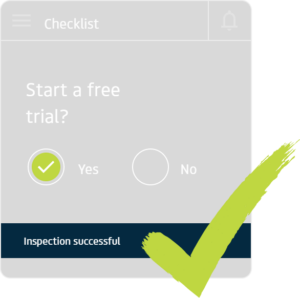
No-code apps give industrial companies the opportunity to drive digitalization forward without having to invest large amounts of IT resources.
Employees can design digital processes – without any programming knowledge! This empowers skilled workers to work on digital processes.
The trend towards no-code also represents an opportunity for companies to bring more agility to rigid processes. And without sacrificing security standards. All in the spirit of agile and stable.
In this article, we explain what exactly is behind the term no-code and what it brings to industrial companies.
What is meant by “no-code”?
No-code means that users can design programs without having to interact with the backend (i.e. the program code).
“No code means configuring instead of programming.”
In principle, no-code means that digital workflows and processes do not have to be programmed. Instead, they can be configured and set via an administration screen.
This means that anyone can develop a digital process. And not in the language of software developers, but via a user interface that is easy to understand.
In short: With no-code, apps can be designed without writing a single line of code.
Difference between no-code and low-code.
The terms no-code and low-code are often used identically – but this is not actually the case. While low-code still requires programming knowledge, no-code is exactly what the name suggests: Designing apps without programming knowledge.
In a nutshell: Users still need programming knowledge for low-code. No-code, on the other hand, requires no code at all and can be configured via a user interface as described above.
No-code platforms and apps.
The term “no-code platforms” or “no-code apps” is usually used.
These development platforms give employees from all specialist areas and industries the opportunity to design solutions for the problems they face on a daily basis.
With no-code platforms, there are usually two access points: one for the employee who designs the digital process. This is where settings can be selected and workflows developed.
And then there is access for the end user. Simplicity is the key here. The user interface should be as simple and self-explanatory as possible.
Examples of use cases for no-code apps.
Two ingredients are needed to start no-code app development in a company: a no-code software toolkit and a use case.
There are many use cases. We have compiled a small list of the most common applications (in the manufacturing industry) here:
- Digital work instructions
- Store floor management
- Quality controls
- Machine maintenance
- Release processes
- Field Service
- EHS checks
- Instructions for audits
- Analysis dashboard
The appropriate content can be compiled and functionalities stored in the no-code app.
What are the advantages of no-code platforms for industrial companies?
Developing solutions. Directly at the scene of the action.
With no-code, the development of digital processes is placed in the hands of those who are closest to the processes and operational tasks themselves.
The advantage of this is that specialists usually have the best understanding of the challenges and problems in their specialist area. They are directly involved in what is happening and therefore know best what solutions and improvements are needed.
If you give these specialists a tool with which they can build the solutions themselves according to their own ideas, something spectacular happens. Because combining specialist expertise and app development leads to efficient, tailor-made solutions!
Fewer IT resources.
IT specialists and programmers are scarce and expensive. Companies must therefore decide wisely how best to deploy these resources.
No-code as a solution: Since no-code platforms do not require any special IT or programming skills, skilled workers and employees from other departments can be empowered to digitize processes independently.
This allows you to deploy your IT resources where the IT experts are actually needed instead.
More agility. Less rigid processes.
The VUCA world presents many companies with the challenge of keeping pace in a fast-moving environment. Agility is the key for companies to adapt quickly to new requirements.
A no-code app can be an enabler for all companies striving for more agility! Fast iterations and decentralized innovations are encouraged. Changes can be responded to more quickly on site. Without long communication channels and waiting times.
One concern that some companies have is that security cannot be guaranteed during the transition to a more agile way of working. With the right no-code platform, however, this is not a problem. A clean database and documentation, transparency can be ensured. Release processes and information flows can also be mapped in no-code apps.
Agility and stability are not contradictory, but go hand in hand.
No-code as a success factor for more agility and better process optimization.
A digitalization project without no-code usually looks like this: A complex IT project is launched. The employees in the specialist department describe the required solution to the IT department or an external app developer in many long meetings.
The end product is often not optimal because the app developers lack proximity to the operational tasks and problems. Or the wrong features are developed due to miscommunication. Changes to the solution are usually also lengthy procedures.
With no-code, it’s a different story: No long communication channels. Changes can be made quickly and practically. Without having to rely on the IT department or external developers.
This means that even small, iterative improvements can be made more quickly.
Making good decisions for process optimization. Based on data analytics.
Replacing the classic paper-based way of working with no-code apps has many advantages. One of the most important advantages is that information is recorded and available immediately via the app. No more delays caused by typing out information. The data can be merged via apps. And displayed in analysis dashboards.
The data from real-time analysis dashboards provide a good decision-making basis for companies. Real-time dashboards enable changes to be detected quickly and a rapid response to be made.
However, this data is particularly valuable for process optimization. It is possible to see where most problems occur, where there are redundancies and where there is potential for improvement.
With the no-code platform, plant managers can view user-defined KPIs at any time and see whether process changes are having a positive impact on the company’s goals.
The findings for process optimization can then be put into practice immediately. There is no need to plan a complex IT project; the digital processes can be implemented directly by the specialist department.
This is what no-code can look like in practice:
One example of a no-code platform is Testify’s software construction kit.
No programming knowledge is required to develop checklist processes, work instructions, workflows and more. True to the motto: configuring instead of programming.

In the picture you can see an example of the interface of a no-code platform.
Testify is a modular system that enables you to digitally control, document and analyze all types of mobile testing and quality processes. The modular system follows the guiding principle of no-code.
Conclusion.
In the fast-moving environment in which companies have to operate, no code is a decisive success factor.
No-code empowers employees to design digital processes themselves. It offers the opportunity to get employees excited about (digital) process design.
This means that rapid adjustments can be made directly on site at any time. Processes are designed to be more agile and can be optimized more quickly. Company resources are thus optimally deployed.